Tuesday, November 28, 2006

Finally Truth about the Iraq Civil War!
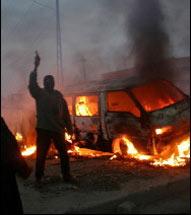


The GOP/conservative media influence machine has done an excellent job of cowing the US media into not admitting that Iraq is in a CIVIL WAR, and has been for many months. Now, finally, a few of them are taking the "big" jump to conclude (and justify) that the country is suffering a civil war. And David Letterman tonight joked that Bush is saying that it isn't a civil war until there's a series of Time/Life books about it!!! Pete

Media Starting to Describe Iraq Conflict as "Civil War"

By Anna Crane
Editor and Publisher

Monday 27 November 2006

New York - For months, the media have been torn over use of the term "civil war" to describe the descent into outright murder and torture in Iraq. Apparently the utter chaos and carnage of the past week has finally convinced some to use "civil war" without apology - with NBC News and MSNBC joining in today in a major way - but many still hold back, an E&P survey today shows.

The Los Angeles Times was one of the first newspapers to flatly describe the conflict as a "civil war" - without the usual qualifiers of "approaching" or "near" - and did again in the first paragraph of a news report on Saturday. The Christian Science Monitor today refers to a "deepening civil war."

But the main Washington Post story today continued to use "sectarian strife." A widely-published Reuters dispatch today adopted "sectarian conflict" and McClatchy in a report from Baghdad relied on "sectarian violence." Other papers declared that Iraq is on the verge of civil war, but has not gotten there yet, with an Associated Press story calling Iraqi President Jalal Talabani's visit to Iran an effort to prevent "Iraq's sectarian violence from sliding into an all-out civil war."

In a bombshell, however, Matt Lauer on the Today show this morning revealed that NBC had studied and perhaps debated the issue anew, and then decided that it will now use "civil war" freely. "For months the White House rejected claims that the situation in Iraq has deteriorated into civil war," he said. "For the most part news organizations like NBC hesitated to characterize it as such. After careful consideration, NBC News has decided the change in terminology is warranted and what is going on in Iraq can now be characterized as civil war."

He explained: "We should mention we didn't just wake up on a Monday morning and say let's call this a civil war.' This took careful deliberation. We consulted with a lot of people." One of them was retired Gen. Barry McCaffery a longtime NBC consultant, who told Lauer he had been using the expression "civil war" for quite some time, with the qualifier "low grade."

Lauer added: "The White House objects to the terminology that NBC News is now using, and here is part of the statement that they've released: 'While the situation on the ground is very serious, neither Prime Minister Maliki nor we believe that Iraq is in a civil war.' It goes on to say that 'the violence is largely centered around Baghdad, and Baghdad security and the increased training of Iraqi security forces is at the top of the agenda when President Bush and Prime Minister Maliki meet later this week in Jordan.'"

Asked about the civil war tag, CNN's Michael Ware said on Friday from Baghdad: "Well, firstly, let me say, perhaps it's easier to deny that this is a civil war, when essentially you live in the most heavily fortified place in the country within the Green Zone, which is true of both the prime minister, the national security adviser for Iraq and, of course, the top U.S. military commanders. However, for the people living on the streets, for Iraqis in their homes, if this is not civil war, or a form of it, then they do not want to see what one really looks like."

In his column in this week's Newsweek, Fareed Zakaria pulls no punches: "We're in the middle of a civil war and are being shot at by both sides. There can be no more doubt that Iraq is in a civil war, in which leaders of both its main communities, Sunnis and Shiites, are fomenting violence."

The Los Angeles Times story by Solomon Moore had opened: "Iraq's civil war worsened Friday as Shiite and Sunni Arabs engaged in retaliatory attacks after coordinated car bombings that killed more than 200 people in a Shiite neighborhood the day before. A main Shiite political faction threatened to quit the government, a move that probably would cause its collapse and plunge the nation deeper into disarray."

The Los Angeles Times since October has been calling it a civil war, Marjorie Miller, the newspaper's foreign editor, told the Associated Press today. "It's a very simple calculation," she said. "It's a country that's tearing itself apart, one group against another group or several groups against several groups. What country even admits that it is in the midst of a civil war?"

Editors at The Associated Press have discussed the issue and haven't reached a definitive stance, said John Daniszewski, international editor. Most often, the conflict is called "the war in Iraq" or identified with descriptive terms such as sectarian fighting, anti-government attacks or ethnic clashes, he said.

He pointed to the different definitions experts have for civil wars. "From a historical point of view, not every civil war is called by that name, and wars by their very nature are not always neatly categorized," he said, in an AP report. "For instance, the American Revolutionary War, the Vietnam War and the more recent wars in Bosnia and Kosovo were all civil wars according to the broader definition, yet we do not normally think or speak of them that way."

Officials at both ABC News and CBS News said that they discuss the situation all the time, but that there's no network policy to use the term civil war, AP added. "We are not there yet," said Paul Slavin, ABC News senior vice president, noting differing definitions.

But MSNBC's Contessa Brewer said this morning on the air: "Now, the battle between Shiites and Sunnis has created a civil war in Iraq. Beginning this morning, MSNBC will refer to the fighting in Iraq as a civil war - a phrase the White House continues to resist. But after careful thought, MSNBC and NBC News decided over the weekend, the terminology is appropriate, as armed militarized factions fight for their own political agendas. We'll have a lots more on the situation in Iraq and the decision to use the phrase, civil war."

On Sunday, The New York Times reported that some scholars are calling the Iraq conflict a "civil war. " A civil war, it explained, is commonly defined by two criteria: two warring groups fighting for control over political power, and at least 1,000 deaths with at least 100 from each side. Criteria that Iraq meets, easily.

Thursday, November 16, 2006

With Edwards and Democrats Wal-Mart Wants to Play with Fire!


Democrats everywhere should boycott Wal-mart because the store viciously attacked Democratic Senator Edwards simply because he's criticized the Wal-mart corporation and an Edwards staffer mistakenly sought to buy something there. Pete


Edwards acknowledges Wal-Mart query

By MARCUS KABEL, AP Business Writer 6 minutes ago

John Edwards — a vocal critic of the retailer — asked his local Wal-Mart store for help in getting the potential 2008 presidential candidate a Sony PlayStation 3. Edwards said a volunteer did so by mistake.

ADVERTISEMENT

Edwards told The Associated Press that the volunteer "feels terrible" about seeking the game unit at Wal-Mart a day after his boss criticized the company, saying it doesn't treat its employees fairly.

"My wife, Elizabeth, wanted to get a Playstation3 for my young children. She mentioned it in front of one of my staff people," Edwards said. "That staff person mentioned it in front of a volunteer who said he would make an effort to get one. He was making an effort to go get one for himself.

"Elizabeth and I knew nothing about this. He feels terrible about this. He made a mistake, and he knows he should not have used my name," Edwards said.

Edwards said the volunteer was "a young kid" unaware of what he called flawed Wal-Mart policies. He called the Wal-Mart statement an effort to divert attention from its own problems.

After Wal-Mart this summer hired Edelman executive Leslie Dach as its public relations director and put him on the company's executive team, analysts said the retailer would likely become more aggressive toward its critics.

Wal-Mart had noted in a news release Thursday that on the same day Edwards was criticizing the company in a conference call with union-backed activists, the volunteer staff member had asked a Raleigh, N.C., electronics department manager to obtain a PS3 for the ex-senator's family.

From Wal-Mart headquarters in Bentonville, Ark., company spokesman David Tovar said the person who called left a voicemail at the Raleigh store and identified himself as an Edwards staff member. When the manager returned the call, the staff member again identified himself as working for Edwards, and Wal-Mart said it confirmed that with Edwards' office.

The retailer's news release accused Edwards of not wanting to wait his turn.

"While the rest of America's working families are waiting patiently in line, Senator Edwards wants to cut to the front," the Wal-Mart statement said.

The PlayStation 3 console is set to go on sale Friday.

Edwards, the Democrats' vice presidential candidate in 2004, spoke Wednesday to supporters of union-backed WakeUpWalMart.com on a conference call launching the group's holiday season campaign to pressure Wal-Mart for better labor standards.

In the call, he repeated a story about his son Jack disapproving of a classmate buying sneakers at Wal-Mart. "If a 6-year-old can figure it out, America can definitely figure this out," Edwards said.

Previously, Edwards has appeared at WakeUpWalMart rallies.

___

Monday, November 13, 2006

26 After the Presidency in '08


From CQ Weekly: The '08 Race for the White House Begins

Note: This overview of the 2008 presidential race, including profiles of the top contenders, ran in the Nov. 6 issue of CQ Weekly, one day before the midterm elections that returned Democrats to power in the House and Senate. Two of the Republicans profiled, Senate Majority Leader Bill Frist and Virginia Sen. George Allen, saw their presidential hopes severely damaged by Tuesday's outcome — in Allen's case, his chances were all but extinguished by his loss to Democrat Jim Webb. However, we have included them since political comebacks by both cannot be ruled out.

• Democrats: Bayh | Biden | Clark | Clinton | Daschle | Dodd | Edwards | Feingold | Gore | Kerry | Obama | Richardson | Vilsack

• Republicans: Allen | Brownback | Frist | Gingrich | Giuliani | Hagel | Huckabee | Hunter | McCain | Pataki | Rice | Romney | Tancredo

The coming presidential campaign will be the most wide open in eight decades. The future of a war is at stake. There is the potential to elect the first woman, the first African-American — or even, possibly, the first African-American woman.

To most of the political world, the 2008 presidential campaign will be considered under way this week. But, in fact, activity on the hustings in the battleground states, those with the early nominating contests, began within weeks of the day George W. Bush was re-elected in 2004.

In the wake of this week's elections, the margins of control are so narrow that establishing a firm rule over the nation’s direction will not be feasible until the 44th president of the United States is elected on Nov. 4, 2008.

If Tuesday's elections were the midterms, consider 2008 the final exam. And what a brutal test it should be.

By definition, any presidential election makes history. But this one is shaping up as the biggest, baddest, meanest and, quite possibly, the most historic race for the White House in at least a generation.

With Vice President Dick Cheney unambiguously ruling out a bid, the stage is set for an epic battle without an official heir apparent on either the Democratic or Republican side.

“It’s the first cycle since 1928 with no incumbent president or vice president running for the White House,” said University of Virginia political science professor Larry J. Sabato. “As a result, we are seeing the earliest campaigning ever, by the most candidates in both parties.”

The 2008 contest began so early that we already have a dropout. Last month, former Gov. Mark W. Warner of Virginia said he would not be running after making several forays into Iowa, New Hampshire and other early-voting or big-money states — and earning standing among the pundits as a member of the emerging Democratic field’s top tier.

In Iowa, site of the first nominating test, more than two dozen potential presidential contenders from both political parties—including 10 percent of the current governors and 12 percent of the current Senate—have already racked up more than 100 campaign trips there since the last election. And the pace is picking up in early-primary states such as New Hampshire and South Carolina.

Many of the White House hopefuls set up their federal exploration committees long ago. As a group, they have already raised a cash total that is now climbing above the tens-of-millions range. Permanent staffs have been hired. Direct-mail campaigns are under way. Consultants have designed logos, tested slogans and even made bumper stickers.

Civilians not accustomed to the guerrilla warfare of a presidential campaign might well think it is amazingly early for so many candidates to be so active. Not so. To win the biggest political prize on Earth, it pays to start now. Indeed, those who have not at least begun testing the waters by now might already be too late — so much of the big money and so many of the smart campaign people having already been spoken for.

Lining up top-shelf strategists and policy experts almost becomes a primary campaign unto itself at this early stage.

Hillary Rodham Clinton is set to inherit the bulk of her husband’s constellation of political stars, James Carville first among them. And John Edwards has won the services of a top rural strategist, Dave “Mudcat” Saunders. But many of the major Democratic operatives, while quietly placing their bets on potential candidates, are hedging those bets until Clinton makes a final decision on whether to run.

On the Republican side, John McCain is mainly sticking with the team he assembled for his run in 2000 and has added some interesting names on the policy front, among them former Clinton administration drug czar Barry McCaffrey. Mitt Romney, though, scored a coup in signing on Mike Murphy, who was McCain’s top adviser last time. George Allen attracted the services of GOP super-nova Mary Matalin and former Republican Party Chairman Ed Gillespie.

But nobody has won the biggest prize of all in this subcampaign — the ear of Karl Rove, the president’s longtime political Svengali, who has painstakingly avoided even hinting at who he might help, or even whether he will join the fray at all.

No Exaggeration

Would-be presidents are scrambling to the field so soon thanks to a genuine power vacuum in both political parties. For once, it is not hyperbole to call an election one of the most important ever, as politicians tend to say every four years — especially when it’s their moment to make history.

Republicans must debate what to do after the Age of Bush, a period that featured two decades of party rule by a single family — George W. Bush’s two presidential terms following the four years that his father, George Bush, spent as president starting in 1989.

A threshold question for Republicans in their nomination struggle will test the fate of social conservatism’s influence. President Bush built a victorious coalition squarely founded upon the support of evangelical Christians, who are one of the most effective grass-roots players in the history of American politics. But their intensely conservative social agenda disturbs enough Americans that many Republicans, including some of the major 2008 contenders, are eager to make this next campaign about moving the GOP toward the center.

Much will depend on who among the Republicans will claim the mantle of social conservatives’ darling, which the president himself will be shedding, and whether that person will possess Bush’s skill at leveraging the religious base without narrowing his appeal to the rest of the electorate.

On economics, Bush has struggled to bridge a widening gap between Wall Street and Main Street, and the next nominee will be pressed to manage that rift. This tension was at the root of the roiling Republican debate over immigration, for instance. Big business, with Bush at its side, pushed GOP congressional leaders for changes aimed at legalizing the status of millions of immigrants. But rank-and-file Republicans balked in a fury, scuttling the Bush initiative.

The officially leaderless Democrats, for their part, will be in search of someone who can pull the party’s varied factions together into a winning coalition — a task that even this week's sweeping victory might not come close to accomplishing.

Trickiest for the crop of Democrats running for president will be how to win over the legions of party activists who want to immediately withdraw U.S. troops from Iraq. It will be tempting for candidates to get on the good side of these voters, who are likely to dominate the primary balloting, but the obvious risk is being tagged by Republicans as weak on national security, a brand that has hobbled the party more often than not since Vietnam.

Of course, the best-case scenario for both party’s candidates would be for the Iraq War to become a non-issue in the 104 weeks before Election Day 2008. But even if the Bush administration some day does begin significantly reducing troop levels, it seems a remote possibility that Iraq will not remain a national headache in two years.

The stakes for the country in the next election are as high as they are for the political parties. Polls show that voters are disgusted with the country’s direction. With two years of bitterly divided government ahead of them, the voters are likely to be even unhappier when they choose the next president.

Look for the White House race to echo much of what was heard in the midterm elections, a tug of war between stay the course or time for a change. Republicans must offer some change, while making the case for keeping the status quo of a GOP-held White House. Democrats must argue for change, but without scaring people.

They have 14 months until the votes are counted in the living rooms, cafes and schoolhouses of Iowa. And then at least two people, one Republican and one Democrat, will start moving toward a place in history. They will probably come from the roster of people, a baker’s dozen from each party, whose current strengths and weakness — political, ideological and financial — are sketched in alphabetical order below.

The Democrats


Evan Bayh — Junior Senator, Indiana

Rationale: A red-state darling and the son of another Democratic senator from Indiana — Birch Bayh, who sought the presidency in 1976 — this telegenic graduate of Washington’s prestigious St. Albans School is a proven vote-getter in his home state, winning two terms as governor (he served from 1989 through 1996) of a state that Democrats have not carried in a presidential campaign since the Johnson landslide of 1964. A dedicated centrist and a senator since 1999, he served from 2001 to 2005 as chairman of the Democratic Leadership Council, the middle-of-the-road policy group once headed by Bill Clinton and Joseph I. Lieberman. In a blitz of campaigning for Democratic congressional candidates in 25 states this year, he has aggressively positioned himself as a Washington outsider, telling stump audiences, “The gulf between our nation’s capital and the people of our country has never been greater.”

Resources: With more than $10 million in his account, Bayh should have no trouble meeting the cover charge to run a credible nomination campaign. His home state’s relative proximity to all-important Iowa will help him muster a network of grass-roots activists. His frequent trips to Iowa and New Hampshire in the past year have attracted local media interest and favorable comments. And his movie-star looks helped make an instant hit of his profile on the popular Facebook.com, drawing more than 2,000 “friends” to sign up.

Hobby Horse: Stressing fiscal responsibility, lower taxes, job creation and lean government, this is one Democrat who hopes to dodge the liberal label so often pinned on his party brethren in national campaigns. His Capitol Hill voting record shows that, until recently, he sided with President Bush on key issues more often than not.

Hobble Horse: Coming across as a mild- mannered Midwestern deacon is not what presidential campaign audiences expect — and in Washington, he is viewed as an intellectual lightweight. To compensate, Bayh asks Democrats, “Do we want to vent, or do we want to govern?” He might find that primary voters prefer venting.

Back to top

Joseph R. Biden Jr. — Senior Senator, Delaware

Rationale: A Democrat who talks the way many people talk, Biden’s vernacular style is frequently on display in his many appearances on radio and television news shows, such as his regular gigs with syndicated host Don Imus. Despite spending more than half of his life in the Senate, the world’s most elite political club — he arrived in 1973, when he was 30 — he seems to have a genuine instinct for middle-class sensibilities. Before the Iraq War, most Americans knew him from a series of bruising Judiciary Committee battles for Supreme Court nominations as he delighted liberals with his ferocious assaults on Republican presidents’ choices. In past years his seat on the Foreign Relations Committee afforded him the chance to travel frequently to Iraq and stand out as one of the most vocal critics of the Bush administration’s handling of Iraq.

Resources: Biden never has faced genuinely difficult re-election races in Delaware, a small state where he has not needed to develop a large financial donor base — at least by presidential campaign standards. This has left him chronically unable to raise enough money to match his White House ambition, which manifested itself in a short-lived run in 1988 and dalliances almost ever since. Still, his popularity with broadcast news producers and personalities gives him a tool for reaching voters that most rivals envy.

Hobby Horse: Despite voting for the 2002 resolution authorizing the Iraq War, Biden dissects the war’s subsequent troubles with relentless passion and a knack for explaining his views in ways that average folks can grasp. And he takes great delight in pointing out that recent White House policy adjustments track his own longstanding suggestions.

Hobble Horse: If Biden could raise big bucks he would have been a serious contender in any of the last several presidential campaigns. And despite his average-Joe demeanor in public, his 33 years in the Senate — along with his reputation as the very model of a long-winded lawmaker — tag him as a creature of Washington. So, too, would the target-rich database of thousands of roll call votes from which opponents could cherry-pick.

Back to top

Wesley K. Clark — Retired General

Rationale: In an era of national security concerns that could last a generation, a retired four-star general who has been around the presidential-campaign block should be a most attractive commodity. Now a contributor to the conservative-leaning Fox News Channel, Clark has the opportunity to develop general- election appeal by reaching many voters who distrust the Democrats. Although unsuccessful in what experts deemed a disorganized 2004 bid for the Democratic nomination, he performed well enough to earn the undying loyalty of moderate voters attracted to his background as West Point graduate, wounded Vietnam veteran and NATO commander during the Kosovo conflict. Having run before and established modest political credentials, Clark — lacking experience as an elected official — might not be at as much of a disadvantage in a second run.

Resources: Raising $30 million in his first outing on the presidential field was not too shabby, but so far Clark has not begun to put together a serious war chest. Since most of his 2004 campaign funds came from individual donors, thanks to an effective Internet program, it is likely that he could raise plenty of start-up cash quickly if he decides to run again. But the major-league Democratic donors have shied away from him so far.

Hobby Horse: As the only potential contender in either party with such a distinguished military résumé, Clark commands attention as long as voters rate the war in Iraq as a top concern. His experience in handling the Kosovo conflict and helping negotiate the Bosnia peace accord give him unrivaled credibility.

Hobble Horse: Although Clark’s lack of experience holding elective office is a plus to some voters, it is likely to remain a hindrance in the eyes of media and political elites. And he has not effectively used his time since the last campaign to shore up his credentials on the domestic front.

Back to top

Hillary Rodham Clinton — Junior Senator, New York; former First Lady

Rationale: Having evolved from Goldwater girl to first lady to player on the mighty Senate Armed Services Committee, Clinton is better known and more road-tested than any of her rivals and is by far the most politically viable woman ever to ponder the presidency. She is hugging the ideological center to shed the liberal, big-government image she acquired in a failed attempt during her husband’s presidency to radically change the nation’s health care system. But now she is tacking rightward, backing federal legislation against flag burning, refusing to recant her vote in 2002 to authorize the Iraq War — even sounding a distinctly centrist tone on abortion. And she seldom misses an opportunity to emphasize her conservative Republican roots growing up in the Chicago suburbs. A recent HBO documentary about Barry Goldwater prominently featured pictures of her as one of his teen supporters along with interviews of her warmly praising the father of modern conservatism.

Resources: Insiders say she will tap former Democratic National Committee Chairman Terry McAuliffe, a longtime Bill Clinton fundraiser, to oversee a nomination campaign with a donor budget expected to at least double the record-shattering $100 million that George W. Bush stockpiled in 2000. She has surprised observers by spending so much on her shoo-in second term Senate campaign, however, which means that she will not have as much left over for a presidential bid as she could have — and has fueled speculation that she might not actually run.

Hobby Horse: Clinton is a passionate policy wonk with a think tank to prove it. Founded three years ago as a refuge for Clinton administration alumni, the Center for American Progress has become an emerging force within the Democratic Party, sometimes outdoing the party’s congressional leaders in taking on the Bush administration.

Hobble Horse: A stilted and sometimes boring performer on the stump, she pales in comparison with her husband when it comes to revving up crowds. And she seems cozier with the many Hollywood stars who are flocking to her cause than with the average folks she most needs to win over.

Back to top

Tom Daschle — former Senate Majority Leader, South Dakota

Rationale: Call it buyer’s remorse, the notion that a nation once so high on George W. Bush might possibly embrace the man who led the Senate Democrats for a decade but lost his bid for a fourth term in South Dakota in 2004 after going toe-to-toe with the White House throughout the president’s first term. Now that Bush is at rock bottom with voters, perhaps they would see Daschle’s partisan warring — once so successfully targeted as “obstructionist” by the Republicans — as a badge of honor worth a belated reward. Grass-roots Democrats especially might be receptive to repaying a debt to Daschle. And with the pivotal state of Iowa neighboring his home state, he has a chance to play a role akin to that of the martyred favorite son in the first nominating contest of 2008.

Resources: As Democratic leader, Daschle was able to raise $20 million for his 2004 race back home, or $51 on every vote cast. Building the even more substantial war chest required for a presidential campaign could be an uphill struggle without the platform of an influential Capitol Hill post to help attract donors. Despite launching a new political action committee last year and testing the waters with trips to Iowa and New Hampshire last summer, Daschle has not revved up his fundraising sufficiently to convince skeptics that he can get his groove back on the cash front.

Hobby Horse: Daschle can argue that he was out front against Bush when it was hard, when the president was rated so high in the polls that many Democrats ran for the hills. And from his perch at the Washington lobby shop of Alston & Bird LLP, he has an opportunity to maintain access to party fundraisers who favored him in those heady days as a Senate leader.

Hobble Horse: Having pulled out of an expected presidential race last time, when he was at the height of his influence, Daschle could easily be written off as a has-been and a loser. Although a recent stint debating former GOP House Speaker Newt Gingrich in California earned them both points for across-the-aisle creativity, it seemed to make both men look very retro.

Back to top

Christopher J. Dodd — Senior Senator, Connecticut

Rationale: In an era when liberal Democratic partisans see the party’s move to the ideological middle of the road as caving in to conservatives, Dodd is the true-blue alternative to centrism. Although he voted in favor of authorizing the war in Iraq, Dodd’s liberal credentials are solid. He has a 91 percent support rating from the AFL-CIO and sided with President Bush only one-third of the time on the Senate floor last year. Dodd is a popular speaker in Democratic circles, easy-going and humorous even while hurling verbal spears at the opposing party. Within his robust résumé as a senator since 1981 — and as chairman of the Democratic National Committee from 1995 until 1997 — Dodd has the tools to bolster his case.

Resources: Dodd has raised more than $1 million to fund contributions to Democratic campaigns in the midterm election, but it will take much more to seriously get into the presidential game. Corporate givers are not fond of his longstanding opposition to their pet projects, such as restricting shareholder and class action lawsuits. Still, his home state is home to many wealthy givers, and his politics should appeal to the Hollywood money crowd.

Hobby Horse: Although he’s a liberal, he is a pragmatist known for cutting deals at the last minute to shape legislation that he opposes more to his liking. In 2005, for instance, he gave in to Republicans on a bill to restrict class action lawsuits after winning concessions from them.

Hobble Horse: Another New England liberal might not be the ticket Democrats are looking for after walking the plank in 2004 with John Kerry of Massachusetts. And Republicans in Florida would have a field day with his strong support for opening up relations with Cuban dictator Fidel Castro.

Back to top

John Edwards — former senator, North Carolina; 2004 vice-presidential nominee

Rationale: As one of the few political figures on the national stage who routinely talks about fighting poverty, Edwards was a natural for the debate on helping the impoverished citizens of the Gulf states after Hurricane Katrina hit a year ago. His come-from-nothing personal story — the first in his family to go to college, he became a multimillionaire personal-injury trial lawyer before his election to the Senate from North Carolina in 1998 — makes him the genuine article when it comes to appealing to the middle class. One of the most popular speakers on the Democratic chicken-dinner circuit, Edwards is keeping a high profile outside Washington. He impressed Beltway insiders weary with Democratic waffling on the Iraq War when he wrote a Washington Post op-ed last year plainly stating that he was wrong to vote for authorizing the war while in the Senate.

Resources: Edwards raised $2.5 million for his One America Committee in the 2006 election cycle, funding a full-time staff and other expenses for one of the most aggressive PACs of the presidential wannabes. As happened at the outset of his 2004 run for the Democratic nomination, his seed money — nearly $1 million — comes from lawyers, presumably drawn to Edwards’ own background. Broadening that donor base will be a major objective for him.

Hobby Horse: Edwards is all but living in Iowa, where a poll last June showed him in first place, ahead of Hillary Rodham Clinton. Iowa insiders say he has natural appeal in the state — the Des Moines Register endorsed him in 2004 — and might have won the presidential caucus if he had maintained a stronger grass-roots organization.

Hobble Horse: Washington’s political insiders tend to dismiss Edwards as a poor performer on the 2004 national ticket who came across as a lightweight in the debate with Vice President Dick Cheney and could not even help carry his home state of North Carolina.

Back to top

Russ Feingold — Junior Senator, Wisconsin

Rationale: The ultimate insider-acting-like-an-outsider, Feingold often breaks ranks with his party and sometimes the entire Senate. The campaign finance overhaul enacted in 2002 over the objections of the leadership in both parties is known as the McCain-Feingold law. Perhaps the most uncompromising liberal in the Senate, Feingold’s name appears as the only dissenter in the occasional Senate roll call. His lone-ranger status forever endeared him to civil libertarians in 2001, when he cast the single vote in the Senate against the counter-terrorism law dubbed the Patriot Act — and did so just six weeks after the Sept. 11 terrorist attacks. More recently, party leaders refused to even seek a vote on his resolution to censure Bush for ordering “warrantless” surveillance.

Resources: Even Democratic Party insiders grumble that Feingold goes too far in spurning the campaign finance system by refusing to accept most forms of outside money, even before McCain-Feingold took effect. Still, he has managed to raise more than $2 million for his presidential exploration fund, most of it from individual donors. The law he helped write could level the playing field to his advantage, as rivals must play by the rules he set.

Hobby Horse: No one in the presidential field for both parties has a better track record for advocating clean government, even when his stands irritate his own party’s leaders. Voters cynical about corruption in Washington should find him to be a refreshing exception and tireless champion.

Hobble Horse: Feingold’s social liberalism — he opposes the death penalty and supports gay marriage — delights his loyal followers, but it could be a devastating target in a general election and severely limit his reach into middle America. He didn’t help matters by once referring to Greenville, Ala., as a place of “check-cashing stores and abject trailer parks.”

Back to top

Al Gore — former Vice President; 2000 presidential nominee

Rationale: Revenge-minded Democrats could have a champion in Gore if they want a do-over of the 2000 presidential election, which many believe he actually won. After wandering in the wilderness after that bitter loss, Gore re-emerged to popular acclaim as George W. Bush was tanking in the polls. It is tough to discount his claims that the United States would not be mired in Iraq if he had become president. And he restored some of the old luster by starring in a critically acclaimed film, “An Inconvenient Truth,” alerting audiences to the dangers of global warming. While once rejecting any notion of another race, Gore has recently cracked the door open a bit. Party insiders believe that he will definitely run if Sen. Hillary Rodham Clinton opts out.

Resources: Gone are the heady days when Gore, as the two-term incumbent vice president under Bill Clinton, raised well above $100 million for his second presidential campaign. (He first ran in 1988, the year he turned 40, when he was a freshman senator from Tennessee.) Four years ago, when he toyed with another try, many of his financial backers abandoned him, a major factor in his final decision to sit out the 2004 campaign. If Gore joined the 2008 field, associates say he would shun the big bucks — out of necessity — and try to make it an asset by running as an outsider.

Hobby Horse: Global warming and the environment enthuse Gore like no other topic, although some observers note that he failed to make those issues much of a priority while he was vice president. On the Iraq War, he parted with Bush and most congressional Democrats in vehemently opposing the invasion early on.

Hobble Horse: Endorsing Howard Dean for president in 2003 was a sign to some Democratic insiders that Gore had simply lost his way, reducing his appeal to the party’s fringe elements. And his global warming obsession is not viewed as a big enough platform to revive a presidential bid.

Back to top

John Kerry — Junior Senator, Massachusetts; 2004 presidential nominee

Rationale: The preferences of a few counties in southern Ohio cost Kerry the electoral votes that would have made him president last time. Since he came so close against an incumbent, he could put it over the top in a race for an open seat in the White House — especially considering that, since the 2004 election, the country has turned against Bush on the war in Iraq. Battle-worn from that race, the 22-year senator from Massachusetts says he has learned crucial lessons in how to run against Republicans. Primarily, he vows to fiercely defend attacks, evidenced by his initial refusal to apologize last week when Bush assailed him for joking that young Americans must get educated or “get stuck in Iraq.” Instead, Kerry counterattacked, calling the president’s aides hacks who are “willing to lie.” He apologized for the gaffe the next day.

Resources: Money is the least of Kerry’s problems. He raised nearly $350 million for his last presidential campaign and nearly $6 million in the 2006 cycle for his political action committee, Keeping America’s Promise. His personal wealth, mostly from the fortune of his wife, Teresa Heinz Kerry, came in handy in his first national run, when he infused his Iowa caucus campaign with his family money in the final days and eked out a win that propelled him toward the nomination.

Hobby Horse: Kerry has determinedly used his Senate platform to extend his campaign against President Bush and fuel another presidential bid. He turned much of his 2004 campaign policy agenda into a legislative agenda. Just a few weeks after that election, for instance, he retooled his campaign health proposals into the first bill that he introduced.

Hobble Horse: Last week’s imbroglio over what Kerry himself termed a “botched joke” — which, to many, appeared to suggest that American soldiers are uneducated — was yet another reminder to Democrats of how clumsy he can be on the stump. It forced him off the campaign trail as fearful Democratic candidates canceled his appearances.

Back to top

Barack Obama — Junior Senator, Illinois

Rationale: Right now he holds one of the hottest cards in American politics, his initial flirtation with a 2008 campaign generating so much enthusiasm that media pundits have labeled the nation beset with “Obama fever.” With his deep baritone voice and Lincolnesque physicality, he has Oprah Winfrey swooning and Democrats cheering, attracting massive audiences on a White House exploration itinerary thinly disguised as a book tour. Although Obama once flatly ruled out a presidential bid so early into his first Senate term, on NBC’s “Meet the Press” last month he acknowledged that he could well change his mind. On paper it would seem much too early in his career for such a run, but when you are holding such hot cards it is tempting to play them.

Resources: Anyone who can stir the waves as he has done usually finds that the money flows in. He raised $15 million for what was a cakewalk 2004 Senate campaign and more than $4 million this year for a federal political action committee that presumably would become his presidential exploration fund. Obama’s biggest PAC contributors come from organized labor, and it seems he delivers, already earning a 100 percent support rating from the AFL-CIO for his Senate votes.

Hobby Horse: Obama has captivated the imagination of baby boomers in an ironic way, by arguing in his new book, “The Audacity of Hope,” that it is time for American politics to move beyond them and the polarizing issues of their growing-up years in the 1960s. His forward-looking message clearly resonates with many Americans.

Hobble Horse: Although many political experts say the country would be open to electing an African-American president (his father is from Kenya, his mother is a white woman from Kansas), it would be a racial gamble for the Democratic Party to nominate only the third black senator since Reconstruction. And his far-from-ripe career on the national stage, while evoking memories of a youthful Jack Kennedy, is bound to give pause among some voters.

Back to top

Bill Richardson — Governor, New Mexico

Rationale: For starters, ethnicity and geography argue in favor of Richardson, a Latino governor in a battleground state that backed Al Gore in 2000 but George W. Bush in 2004. Add to that his varied Washington experience — 14 years in the House plus four years in the Clinton administration, first as U.N. ambassador and then as Energy secretary — and on paper you have the ingredients for national office. Richardson is a larger-than-life character who is charming on the stump. On policy matters, he is a pragmatist who remains quite popular in his politically fluid state, recently winning kudos for making good on a 2003 campaign promise to save taxpayers $90 million in state budget costs. Governors do well in presidential contests, which is enough of a reason to consider Richardson a player.

Resources: Richardson raised more than $8 million for his bid for a second term as governor this year, a sizable sum in New Mexico politics. And his shoo-in standing in that race has allowed him to spread his money around to other Democrats in the state, always good for earning chits to solidify his home-state base in a presidential campaign. Also, the bulk of his campaign funds come from business interests instead of big labor, a good talking point for any Democrat in a general-election bid.

Hobby Horse: Richardson earned foreign- policy credentials as the ambassador to the United Nations, troubleshooting hot spots from Iraq to North Korea, and he also can emphasize his popular management of New Mexico and tout what is expected to be a lopsided re-election victory.

Hobble Horse: Richardson’s closet is not entirely clean. At a minimum, a presidential bid will again bring to light his brush with the Monica Lewinsky scandal, in which he reportedly offered her a job, and revelations that for years he erroneously claimed to have been drafted as a pitcher by the Kansas City A’s.

Back to top

Tom Vilsack — Governor, Iowa

Rationale: Vilsack’s hopes are pinned to a four-letter word: Iowa. As the outgoing governor of the state that has the first presidential nominating contest, he owns the place. Democrats take note that he was the state’s first governor from their party in 32 years. In recent years he has worked hard to broaden his portfolio with a heartland-focused message assailing Washington’s pork barrel spending and arguing for an end to what he derides as corporate giveaways in federal budget and tax policies. He has a strong working knowledge of economics and knows how to appeal to middle class pocketbook worries. His wife, Christie, is a talented politician in her own right and was instrumental in helping John Kerry win the Iowa caucus last time.

Resources: Vilsack raised more than $6 million for his successful 2002 re-election bid, with contributions from business groups edging out labor donors. He has raised a bit more than $2 million for his current political action committee but would need much more to convince party bosses that he can move into the major leagues of fundraising.

Hobby Horse: As one of a handful of governors in the race from either party, Vilsack is well-positioned to run against Washington at a time when voters seem disgusted by corruption in the nation’s capital. And he intends to make his views of the excesses of federal spending one of his primary targets in a presidential campaign.

Hobble Horse: Another Iowan, Sen. Tom Harkin, demonstrated in his 1992 presidential bid that being a favorite son might be enough to win the state’s nominating caucus, but it was much discounted by the national media and proved not to be anything close to a momentum generator for the New Hampshire primary.

Back to top

The Republicans


George Allen — Junior Senator, Virginia*

Rationale: A Ronald Reagan conservative with George W. Bush’s down-home style, Allen has deep appeal to those social conservatives who dominate Republican presidential nominating contests. His background as Virginia governor and a solid conservative voting record during his term in the Senate present a powerful résumé. A year ago, Allen was seen as a top prospect to inherit the conservative chair in GOP circles. But a bruising re-election bid this year against Democrat Jim Webb has seeded ample doubt. Still, his troubles could be a blessing if he wins a second term. Despite his gaffes on the campaign trail and charges of racism in his past, Allen always could argue that these matters have now been vetted fully and dodge further discussion in a presidential run. All bets are off, of course, with Allen's loss this week.

Resources: There once was no doubt that Allen, a fundraising machine, could fund a credible presidential campaign — until his Senate re-election campaign foibles surfaced. Raising almost $14 million for his current race, much of it from outside Virginia, Allen had hoped to save a chunk of the money as seed funds for a White House run. But, instead, he has had to shovel the bulk of it into television ads in a last-minute effort to save his seat.

Hobby horse: Before his political skills were called into question this year, Allen was seen as a major talent on the stump. Never considered much of a policy wonk, he has served the GOP well on the political front, such as his successful management of the Senate Republicans’ 2004 campaign team.

Hobble Horse: Even some Republicans privately say that Allen is not too bright, an image reinforced by his stumbling this year on the campaign trail. With his loss on Tuesday, Allen will likely be seen as damaged goods. And his tough race kept him tied down in Virginia, unable to travel the country earning the favor of other Republicans.

* see note at the top of this story

Back to top

Sam Brownback — Senior Senator, Kansas

Rationale: Brownback has an opening to seek the social conservative mantle in Republican politics, especially if Sen. George Allen loses his re-election bid in Virginia — and with it his viability for 2008. Brownback is no poser on issues of concern to evangelical Christians, who have grown restive about the Republican Party’s real commitment to their cause. In Brownback, they would have a true believer who passionately denounces what he sees as the decay of American culture and has made the championing of social conservatism a centerpiece of his decade in the Senate. He has remained steadfast in opposition to stem cell research — a litmus test for anti-abortion conservatives, who view the harvesting of embryonic stem cells in the cause of medical breakthroughs as the destruction of human life. While others in his party are looking for room to wiggle toward the center on that and other socially divisive issues, Brownback has stayed put. None of his potential 2008 rivals can beat his ties to politically active religious leaders on the right.

Resources: Although he raised a respectable $2.7 million for his breezy Senate re-election campaign in 2004, Brownback has no experience in the major leagues of presidential campaign fundraising. His current political action committee, Restore America, raised just under $600,000 over the past two years. But if he can ignite the evangelical grass roots for a White House drive, Brownback could overcome a money deficit.

Hobby Horse: Brownback has cultivated Mideast credentials since the aftermath of the Sept. 11, 2001, terrorist attacks when he began making use of his standing at the time as the top-ranking Republican on the Near Eastern and South Asian Affairs Subcommittee of the Senate Foreign Relations panel. Since then, he has developed a reputation for expertise on Afghanistan and the Muslim world.

Hobble Horse: As a darling of the religious right, Brownback might have a leg up for the GOP nomination, but his appeal in a general election could be quite limited. Pragmatic Republicans would likely argue this case against him in the primary campaigns.

Back to top

Bill Frist — Senior Senator, Tennessee; Majority Leader*

Rationale: Before his stunning promotion to majority leader four years ago, Frist was seen as the heir apparent to President Bush’s command of the Republican Party. Many say he was handpicked by the White House for the top Senate job. Despite a lackluster-at-best performance during his four years as GOP leader — and his decision to retire from his Tennessee seat at year’s end — Frist can still argue that his résumé as a transplant surgeon and his political base in the South keep him in the running for 2008. He has struggled to balance his party’s ideological divide. On the one hand, he pleased social conservatives when he set a Senate vote to overturn Florida court rulings that allowed the comatose Terri Schiavo’s husband to have her life support removed. But he irritated evangelicals by taking a strong stand in favor of stem cell research — and in opposition to the Bush White House.

Resources: A very wealthy man, thanks to his own surgical prowess and a family fortune in the hospital business, Frist is comfortable and persuasive among the super-rich who fund major political campaigns. He raised nearly $6 million for his 2000 re-election and, naturally, health industry donors led the way. In the 2006 cycle, he has raised more than $7.5 million for his political action committee. If he runs for president, Frist could be one of the better-funded candidates in the field.

Hobby Horse: Frist is working hard to regain the trust of social conservatives after parting company with them on stem cell research. He got out front in the drive to ban same-sex marriage, even though it was a non-starter in the Senate. He knows that winning over the evangelicals is his first order of business for renewing interest in his presidential prospects.

Hobble Horse: The Senate got little done on his watch, and many conservatives hold him responsible for failing to enact their agenda. And as he tries to make it up to them, moderate Republicans accuse him of pandering to the right wing. Washington insiders who were once so high on his chances now all but write him off.

* see note at the top of this story

Back to top

Newt Gingrich — former Speaker of the House, Georgia

Rationale: In a twist on Jimmy Carter’s 1976 campaign slogan, “Why Not The Best?,” Gingrich could use as his campaign tag line the rhetorical question, “Why Not The Past?” And why not, indeed? Gingrich, who led Republicans to control of the House in 1994 for the first time in 40 years, could be just the one to revive his party’s winning spirit. With one of the sharpest minds in politics and policy, he can outtalk anyone in the game. And none of the party’s current problems, from the Iraq War to the swirl of scandal around lobbyist Jack Abramoff, can be laid at Gingrich’s doorstep. He’s been out of politics since he resigned his House seat eight years ago, giving him the right to chide his party for losing its way, as so many grass-roots Republicans seem to think has happened. All he needs is a new contract with America.

Resources: Having been out of politics and the fundraising game for so long, Gingrich might have trouble getting up to speed. But when he was at the top of his game, as Speaker in 1996, he amassed more than $6 million for one of his more competitive House re-election races in suburban Atlanta. He has kept up ties with the money crowd as a popular speaker on the convention circuit, where well-to-do business leaders congregate.

Hobby Horse: Gingrich gives no ground when it comes to national security, arguing that the nation is already embroiled in World War III and should act accordingly. Although concerns about terrorism were not at the top of the agenda during his days in power, he has written several books about war and misses few opportunities to join the national debate.

Hobble Horse: Some think that Gingrich just talks too much, sometimes sounding like a nutty professor, and is much too eager to be provocative even at the risk of being misinterpreted. Social conservatives distrust him, and it doesn’t help that he’s on his third marriage. And the last big campaign he ran, the 1998 midterm, was a big enough bust for the GOP that it forced him out as Speaker.

Back to top

Rudolph Giuliani — former mayor, New York City

Rationale: No one has ever moved from a city hall to the White House, but Giuliani could be the first for one reason: He still basks in the glow from his role as “America’s Mayor” five years ago, when his considered but forceful stewardship of New York City after the Sept. 11 al Qaeda hijackers’ attacks on the World Trade Center earned him comparisons to Winston Churchill and prompted Time magazine to name him “person of the year.” Other hallmarks of his eight years as mayor, such as fighting crime and cleaning up Times Square, bode well for making his case as a competent manager. He is a sought-after speaker on management topics. And perhaps most important to his political ambitions, Giuliani has tirelessly trooped around the country to leverage his star power stumping for Republican candidates. Despite his moderate social views, he has made a sincere effort to reach out to religious conservatives and talk in personal terms about his own beliefs.

Resources: Giuliani raised $2.4 million for his political action committee, Solutions America, in the 2006 season and gave nearly a half-million dollars to GOP candidates or other campaign committees. Among the home states of his donors, Florida and Texas are in the top five, a positive sign that he can tap the deep wells there for Republican cash. Still, he is untested as a national fundraiser.

Hobby Horse: Competence will be Giuliani's best argument. He takes pride in having run the nation's largest city and surviving the experience well-remembered as an able manager who actually got some things done. And his earlier days as a crime-fighting federal prosecutor could be cited as a credential for fighting terrorists.

Hobble Horse:Giuliani’s views on abortion rights, environmental protection and other domestic issues are far to the left of the typical GOP voters’ And his personal life, to put it mildly, is something of a mess. He has been married three times and his last divorce sparked a tabloid frenzy of charges and countercharges. Main Street Republicans and evangelical Christians might find it all a bit much to handle.

Back to top

Chuck Hagel — Senior Senator, Nebraska

Rationale: Call him the new John McCain. With two Purple Hearts earned as an Army infantryman in Vietnam and cozy relations with the press corps, Hagel comes across as the Republican maverick that McCain once was — before he began courting President Bush and the party’s conservative wing. Early on, Hagel was a rare GOP voice in opposition to Bush’s handling of the Iraq War. He did not let up, despite extreme pressure from party leaders to cool it. As a result, he is a favorite Republican to many Democrats. But he is no wild-eyed liberal, having once voted to overturn the Roe v. Wade protection of a woman’s right to an abortion. For a presidential campaign, geography favors him: His home in Omaha is practically within walking distance of Iowa.

Resources: With just over $1 million raised by his political action committee during the 2006 cycle, Hagel shows no signs of being a campaign-finance powerhouse. He easily won re-election in 2002 with a modest $1.6 million in campaign funds. Chances are that if Bush and his friends have anything to say about it, Hagel will not be tapping a lot of traditional GOP resources. He has been a thorn in the president’s side, and payback is probably on its way.

Hobby Horse: For Hagel, the word is maverick. In an era when voters are disgusted with blind partisanship, he is about as independent as they come. Like McCain and Rudolph Giuliani, his best argument to Republican primary voters is that he could appeal to a wide swath of general-election voters.

Hobble Horse: Plenty of GOP conservatives would rather set themselves on fire than see Hagel win the Republican nomination. They see his persistent criticism of the Iraq War as treason within his party, if not to the nation as a whole.

Back to top

Mike Huckabee — Governor, Arkansas

Rationale: If teaching Americans how to lose weight can make you president, then Huckabee is a shoo-in. After being diagnosed with diabetes in 2003, he set upon a life-changing course of eating less and running more. Now 110 pounds lighter than when he began his exercise and diet regimen, Huckabee last year published a book about his experiences, titled “Quit Digging Your Grave With a Knife and Fork.” As governor, he has argued that promoting healthier living, among both citizens and state workers, ultimately saves taxpayers millions of dollars in medical expenses. Huckabee’s weight-loss evangelism comes naturally. He is a Baptist minister accustomed to inspiring others. As Bill Clinton demonstrated, you do not get to the top of Arkansas politics and stay there without knowing how to charm a crowd. And Huckabee, who has been governor for a decade (and was lieutenant governor for three years before that), gets high marks as a crowd pleaser.

Resources:Huckabee raised $2.3 million for his last governor’s campaign, in 2002. The bulk of his money came from Arkansas business interests and only a little more than 10 percent of his funds came from out of state, suggesting that he might have some difficulty financing a national race. Although Huckabee might possess some of Clinton’s charisma, he does not share his fellow Arkansan’s knack for fundraising.

Hobby Horse: In a party so dominated by religious conservatives when choosing presidential nominees, Huckabee’s status as a Baptist minister should get him a hearing. He and his wife, Janet, entered into a “covenant marriage,” a popular movement among evangelicals in which couples agree to limited legal grounds for divorce.

Hobble Horse: A penchant for granting pardons went awry for Huckabee when he released a convicted rapist, Wayne Dumond, who then committed a murder in Missouri. Look for this story to get plenty of play if Huckabee becomes a credible presidential candidate.

Back to top

Duncan Hunter — Congressman, California's 52nd District; Chairman, Armed Services Committee

Rationale: In these times of national security worries, there is nothing like an ex-Army Ranger to the rescue. In the halls of Congress, where he’s been since 1981, Hunter still comes across as a trained combatant. At the helm of the House Armed Services Committee for the past four years, he has earned a reputation as a blunt and ferocious advocate for the military, especially when it comes to protecting the troops from budget cuts. When the Bush White House wanted to redesign the nation’s intelligence hierarchy, the president, the vice president and many others in the administration had to personally lobby Hunter to back off his firm stand against it. He finally signed on when satisfied that the changes would not threaten the access of soldiers in the field to intelligence data.

Resources: Considering the squads of defense lobbyists who traditionally swarm the Armed Services panel’s offices, running from the Rayburn Building is a fine platform for raising money, and Hunter has mustered war chests in the $1 million range for each of his last three re-election bids — none of which has been remotely close. But if Republicans lose control of the House, Hunter would lose his chairmanship and not be in as strong a position to raise money.

Hobby Horse: Beyond his solid credentials as a defense hawk, Hunter presents a social conservative portfolio that has appeal in GOP presidential primaries. He has long sponsored legislation to ban abortions. And now that building a fence along the Mexican border is in vogue, he can point out that he has proposed doing so for years.

Hobble Horse: Hunter is a powerhouse on Capitol Hill, but outside Washington and his Southern California district he remains a complete unknown. Perhaps he is expecting to have plenty of time to get outside the Beltway and build name recognition after Tuesday.

Back to top

John McCain — Senior Senator, Arizona

Rationale: As close to a Republican heir apparent as anyone gets in the 2008 field, McCain has done his best to earn that title from tradition-minded voters in his party. His positioning as a straight-talking maverick continues to give him clear general-election appeal, so his challenge is winning over social conservatives to get the GOP nomination. Independent voters and more than a few Democrats flocked to his initial presidential campaign. At the risk of losing some of those voters, McCain has courted religious conservatives and buried the hatchet from that bitter rivalry for the GOP nomination six years ago. The result has been a swell of conventional wisdom in Washington that sees McCain as the party’s most likely nominee. Look for the president himself to give that nod at some point if all goes well between the two former rivals.

Resources: Money was tight for McCain toward the end of his 2000 nomination bid, which played a role in his ultimate loss to the massively funded Bush machine. But no one on the horizon for 2008 seems able to duplicate what Bush accomplished, opening the way for McCain to play the role of the presumed nominee and attract the attendant onslaught of cash.

Hobby Horse: While the corruption scandal brought on by convicted ex-lobbyist Jack Abramoff primarily tainted the Republican Party, it could make GOP voters all the more eager to nominate McCain, who has earnestly built a squeaky-clean image — he was, of course, a principal author of the 2002 campaign finance overhaul — despite himself getting caught up in the “Keating Five” savings and loan scandal of the 1980s.

Hobble Horse: Age and health are the biggest worries for McCain. He would be 72 on Inauguration Day 2009, meaning he would be the oldest person to become president. (Ronald Reagan was just shy of his 70th birthday when he first took the oath.) And although McCain says his bout with skin cancer is behind him, it left marks on his face that — along with injuries he suffered as a prisoner of war in Vietnam — deny him the appearance of robust health that Reagan projected.

Back to top

George E. Pataki — Governor, New York

Rationale: The governor’s mansion in Albany was a good enough launching pad to get Theodore and Franklin D. Roosevelt into the White House — but it proved lousy for Mario Cuomo, who had to shelve his national ambitions in 1994 after losing his bid for a fourth term to Pataki, then a relatively obscure state senator. That upset earned Pataki the awe of Republicans nationally. They have watched him ever since, and his stewardship of the state — cutting taxes and creating jobs — has not disappointed them. (He’s not seeking a fourth term of his own this year.) After the attacks of Sept. 11, Pataki was in the national spotlight, side by side with Mayor Rudolph Giuliani, demonstrating a calm competence that made their party proud. Instrumental in bringing the 2004 Republican Convention to New York, Pataki on paper is ready to play an even bigger role at the next convention.

Resources: The state of New York by itself has enough money to potentially fund a presidential campaign, but in 2008 there could be three from the state dialing for dollars: Pataki, Giuliani and Democrat Hillary Rodham Clinton. The Clintons have a tried-and-tested national network. Giuliani has been out of office with plenty of time to travel the country. Pataki, without the track record of the Clintons or the free time Giuliani enjoys, could face a tough challenge finding enough cash elsewhere.

Hobby Horse: A governorship has been the job of choice in four of the past five presidential elections, and Pataki is currently the nation’s longest-serving governor — with plenty of policy achievements to boast about. Tax-conscious conservatives will find Pataki’s tax-cutting record quite appealing. For compassionate conservatives, he can tout his 1999 health care plan extending insurance to those without employer-provided plans.

Hobble Horse: Pataki’s charisma deficit — he’s considered boring on the stump — will not help him charm his way into the hearts of religious conservatives who are not going to warm up to his abortion stand and support of gay rights. Rockefeller Republicans are still not welcome in such circles.

Back to top

Condoleezza Rice — Secretary of State

Rationale: She has said no in every imaginable way, but the political world cannot stop being fascinated with the idea of Rice on the national Republican ticket. She fits the bill for those who think only a solid conservative could ever become the first woman president, let alone the first African-American in the Oval Office. Rice, of course, is both of these — and she would make history just by running and winning a single primary. Careful and calculating in public, Rice makes very few mistakes despite having so many political foes gunning for her. A stalwart in the Bush White House’s war on terrorism, from national security adviser in the first term to secretary of State since last year, she has the policy platform for a credible campaign despite lacking the experience of elected office.

Resources: If the Bush family gets behind her, all things are possible. The president is her biggest fan, and so far no one knows which of the 2008 hopefuls he might favor. Such high-powered backing is probably what it would take for Rice to mount an adequately resourced campaign. She has no experience raising the amount of money needed for such an undertaking, though her fame and rock-star appeal at GOP gatherings could make up the difference.

Hobby Horse: While she has legions of critics, no one can doubt her toughness in the national security arena. She gives no ground, whether on talk shows or in contentious Senate hearings. And the State Department turned out to provide some refuge from the brickbats being hurled at Bush’s war policy, where Defense Secretary Donald H. Rumsfeld has taken ownership of the hot seat.

Hobble Horse: As a presidential candidate, Rice would face endless questions that she now mostly dodges about uncomfortable matters, such as the warnings she received about terrorist activity before Sept. 11. That headache alone could be enough to dissuade her from joining the White House fray.

Back to top

Mitt Romney — Governor, Massachusetts

Rationale: If conventional wisdom is correct and John McCain is the one to beat for the Republican nomination, someone will emerge as the conservative alternative. Bet on Romney to at least have a turn in that spotlight. Most pointedly, he rushed to President Bush’s defense when McCain was taking on the White House plan to expand the authority to interrogate terror suspects. On immigration, Romney has taken a hard line, in contrast to McCain’s middle-of-the-road approach in support of the president’s proposals. And Romney seems to show up in religious conservative country, such as South Carolina, every time McCain tries to make his way there. Romney is doing what Sen. George Allen was planning to do until his own Senate re-election became dicey in Virginia. If Allen is out of play, Romney stands to gain.

Resources: It is hard to know which is better for training as a major league fundraiser, being governor of a good-sized state or running the Olympics. Romney has done both. He raised nearly $9.5 million for his 2002 election as Massachusetts governor (he’s not running again this year), and he compiled nearly $2.5 million for his federal political action committee in the 2006 cycle. And those ties to corporate biggies when he was CEO of the 2002 Winter Olympics in Salt Lake City? Priceless.

Hobby Horse: In an age when politicians cannot stop yammering about health care, Romney did something about it, signing into law last April an insurance plan that covers nearly all Massachusetts citizens without raising taxes. The plan’s emphasis on individual responsibility for premium costs and subsidies for lower-income citizens is already becoming a popular model for Republican-style health care reform.

Hobble Horse: As a Mormon, Romney faces doubts among many evangelical Christians who are suspicious of the denomination. He does his best to disarm the doubters, once even cracking a joke about polygamy, saying that he believes marriage is “between a man and woman and a woman and a woman.”

Back to top

Tom Tancredo — Congressman, Colorado's 6th District

Rationale:One-issue protest candidates are a hallmark of presidential campaigns, and Tancredo aims to make illegal immigration his cause. As Congress’ leading advocate for tighter border controls and the deporting of people who have immigrated illegally, he is riding a wave of conservative sentiment that is roiling the Republican Party. Even some religious conservatives are getting as agitated about immigration as they are about abortion. And Tancredo was on this case long before it was hot. He says that he began focusing on it as a state legislator in the 1970s, when waves of immigrants moved into Colorado, eventually forcing the state to implement bilingual education programs. As a self-described religious-right Republican, Tancredo only gives way to liberals on gun control — a conversion brought about by the 1999 shooting deaths at Columbine High School, just blocks from his home in the Denver suburb of Littleton.

Resources: Protest candidates don’t need a lot of money to maintain their candidacy. A cell phone and a rental car is about all it takes. But Tancredo is no slacker in this regard, having hit the $1 million mark in campaign funds when necessary for his re-elections since first winning his House seat in 1998. His alignment with anti-immigration groups and evangelicals should provide a healthy source of cash and direct-mail addresses to keep a campaign as long as he likes.

Hobby Horse: Tancredo’s long-standing obsession with border fences and other measures to reduce illegal immigration is no longer burdened by the nutty image it once suffered. Last month, President Bush vindicated Tancredo’s movement by signing into law a bill authorizing construction of 700 miles of fence along the Mexican border.

Hobble Horse: The inconvenient truth for Tancredo is that his own grandparents were immigrants. They came to the United States from Italy, but he says they always regarded themselves as Americans and not as Italian-Americans. And since they were legal immigrants, presumably he would not have them deported if they arrived today.